


How to Choose a Hoist for an Overhead Crane
An overhead crane hoist is one of the most critical components of any lifting system used in industrial facilities, warehouses, and production plants. The correct hoist selection directly affects lifting safety, operational reliability, and overall productivity. An incorrectly selected hoist often leads to downtime, accelerated wear of components, and increased maintenance costs.
In this guide, we explain how to choose a hoist for an overhead crane, what parameters to consider before purchasing, which hoist type is best for different applications, and when it is acceptable to choose a cost-effective solution — and when cutting costs is not recommended.
In this guide, we explain how to choose a hoist for an overhead crane, what parameters to consider before purchasing, which hoist type is best for different applications, and when it is acceptable to choose a cost-effective solution — and when cutting costs is not recommended.
What Is a Hoist and Its Role in an Overhead Crane System
A hoist is an electric lifting device designed for vertical lifting and lowering of loads. Within an overhead crane system, the hoist performs the main lifting function, while the crane bridge and structure ensure horizontal movement across the working area.
Key operational characteristics depend on the hoist specifications, including:
Key operational characteristics depend on the hoist specifications, including:
- maximum lifting capacity;
- lifting and travel speed;
- load positioning accuracy;
- service life of the crane equipment.
Main Types of Hoists for Overhead Cranes
Wire Rope Hoist for Overhead Cranes
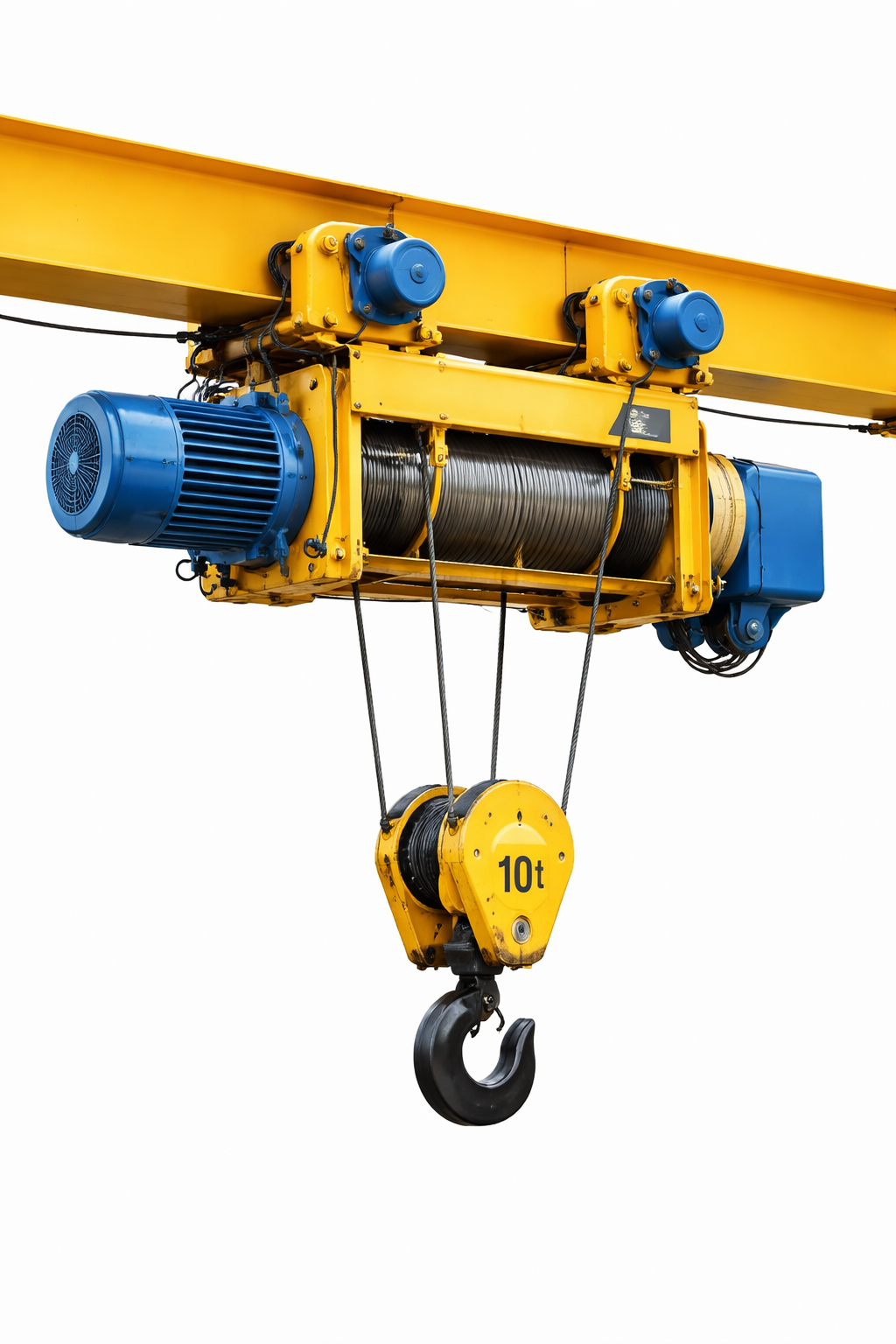
A wire rope hoist uses a steel wire rope wound around a drum. It is the most commonly used solution for industrial overhead cranes.
Advantages:
Disadvantages:
Wire rope hoists are typically used in manufacturing plants and facilities with heavy loads and demanding duty cycles.
Advantages:
- high lifting capacity;
- suitable for intensive and continuous operation;
- smooth and precise lifting;
- long service life.
Disadvantages:
- higher initial cost;
- more complex maintenance compared to chain hoists.
Wire rope hoists are typically used in manufacturing plants and facilities with heavy loads and demanding duty cycles.
Chain Hoist for Overhead Cranes
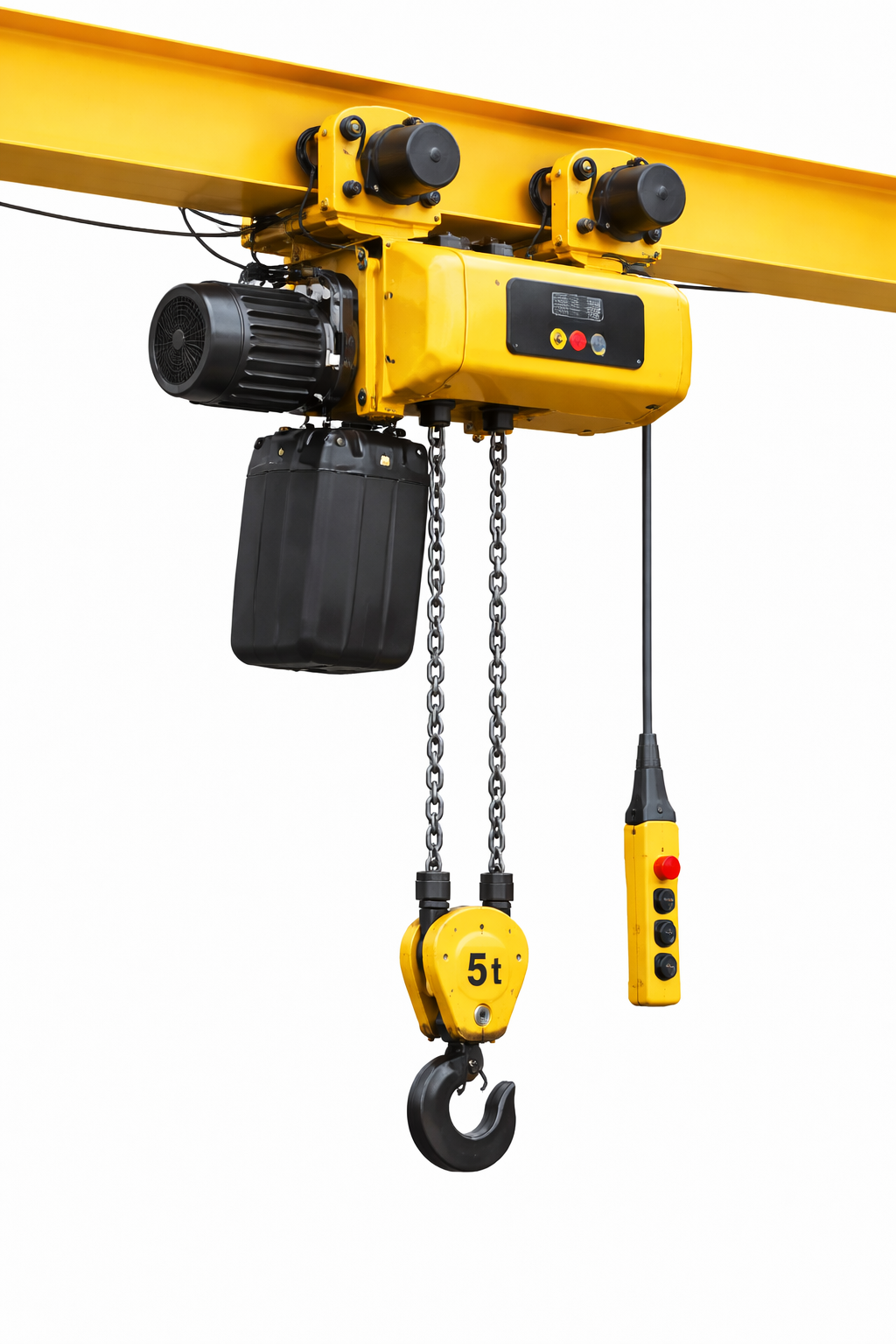
A chain hoist lifts loads using a dedicated load chain.
Advantages:
Limitations:
Chain hoists are well suited for warehouses, service areas, and light industrial applications where lifting intensity is moderate.
Advantages:
- compact design;
- simple construction;
- lower purchase cost;
- easy maintenance.
Limitations:
- lower lifting capacity;
- limited service life under heavy-duty operation.
Chain hoists are well suited for warehouses, service areas, and light industrial applications where lifting intensity is moderate.
How to Choose a Hoist for an Overhead Crane: Key Parameters
Lifting Capacity
When selecting a hoist, it is essential to consider not only the actual load weight but also a safety margin.
Recommended reserve: 10–20%.
This is why the cheapest hoist is rarely the best long-term solution.
Recommended reserve: 10–20%.
This is why the cheapest hoist is rarely the best long-term solution.
Lifting height
The lifting height is determined by:
Insufficient lifting height may make the crane unusable.
- room height;
- overhead crane design;
- technological requirements.
Insufficient lifting height may make the crane unusable.
Lifting and Travel Speed
Different applications require different speeds:
Modern hoists are often equipped with frequency inverters, providing smooth start-up, controlled acceleration, and precise load positioning.
- warehouse operations — standard speed;
- assembly and installation work — reduced speed;
- intensive production — increased speed.
Modern hoists are often equipped with frequency inverters, providing smooth start-up, controlled acceleration, and precise load positioning.
Duty Class (Working Duty)
The duty class defines how intensively the hoist will be used.
Incorrect duty class selection is one of the most common causes of premature equipment failure.
Incorrect duty class selection is one of the most common causes of premature equipment failure.
Which Hoist Is Best for an Overhead Crane
There is no universal “best hoist” — the optimal choice depends entirely on operating conditions:
The best hoist is not the most expensive one, but the one that is technically matched to the load, duty cycle, and operating environment.
- heavy and intensive applications — wire rope hoist;
- light-duty and warehouse use — chain hoist;
- automated systems — hoist with frequency control and positioning features.
The best hoist is not the most expensive one, but the one that is technically matched to the load, duty cycle, and operating environment.
Hoist Price and What Affects It
The price of an overhead crane hoist is determined individually and depends on:
When planning a purchase, it is important to consider not only the equipment price but also installation, servicing, and potential spare part costs.
- hoist type (wire rope or chain);
- lifting capacity;
- lifting height;
- duty class;
- lifting speed;
- control system;
- manufacturer.
When planning a purchase, it is important to consider not only the equipment price but also installation, servicing, and potential spare part costs.
Is It Possible to Buy a Cost-Effective Hoist
Yes, it is possible to buy a cost-effective hoist if:
However, in heavy-duty or continuous operation environments, choosing a low-cost hoist often results in higher expenses over time.
- the load is relatively light;
- the duty cycle is light or medium;
- a standard configuration is sufficient;
- no automation or high-speed operation is required.
However, in heavy-duty or continuous operation environments, choosing a low-cost hoist often results in higher expenses over time.
Hoist Delivery and Installation
When choosing a supplier, it is important to evaluate not only the price but also:
A comprehensive approach reduces installation risks and ensures reliable operation from the first day.
- hoist delivery conditions;
- installation and commissioning services;
- technical support and warranty.
A comprehensive approach reduces installation risks and ensures reliable operation from the first day.
Common Mistakes When Choosing a Hoist
- focusing only on price;
- insufficient lifting capacity reserve;
- incorrect hoist type selection;
- ignoring duty class requirements;
- lack of lifting height calculation.
Frequently Asked Questions (FAQ)
Yes, provided the hoist is compatible with the existing crane structure.
This depends on the supplier and the order configuration.
Yes, after technical evaluation and parameter alignment.
Conclusion
Choosing the right hoist for an overhead crane is an engineering decision that directly impacts safety, efficiency, and equipment lifespan. A professional and well-planned approach ensures reliable operation, optimal performance, and controlled long-term costs.
You may also be interested in

We use cookies on our website

Contact us
Our company managers will be happy to answer all your questions!
+371 67 382 063
We value your privacy
We use cookies to improve your browsing experience, show personalized ads or content, and analyze our traffic. By clicking “I agree”, you agree to the use of cookies.
We use cookies to improve your browsing experience, show personalized ads or content, and analyze our traffic. By clicking “I agree”, you agree to the use of cookies.